
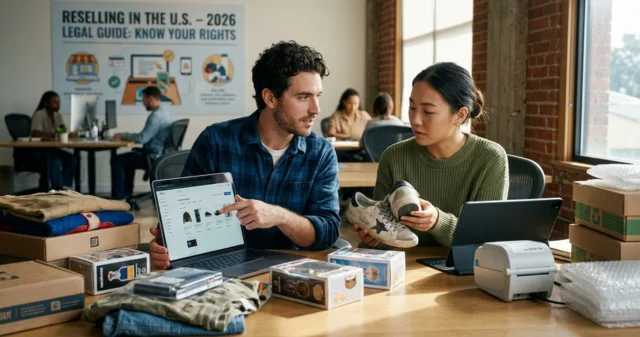
Is reselling legal in the United States? In most cases, yes, especially for genuine physical goods you lawfully own. The answer changes when safety rules, intellectual property, taxes, licensing, or platform policies apply.
Short answer: Yes, most resale of genuine, lawfully acquired physical goods is legal in the United States. Copyright law protects many transfers, while trademark law generally permits genuine-goods resale. Problems arise with counterfeits, recalled products, misleading brand claims, and regulated goods. Digital licenses, taxes, and materially changed products can create separate issues.
| Question | General U.S. rule |
|---|---|
| Can you sell genuine products you bought legally? | Usually yes |
| Do you normally need the brand’s permission? | Usually no for genuine, unchanged goods |
| Can you sell counterfeit products? | No |
| Can you sell recalled consumer products? | No |
| Can you sell opened or altered branded goods? | Sometimes, but trademark risks can increase |
| Can you sell licensed digital products? | It depends on ownership and license terms |
| Is resale income taxable? | Taxable income or gains generally must be reported |
| Do sellers need permits? | Requirements vary by product, state, and locality |
Key Takeaways
- Ownership of a genuine physical item usually includes the ability to sell that item.
- Copyright and trademark rules protect different aspects of resale.
- Counterfeit goods can create serious federal criminal exposure.
- Recalled consumer products cannot lawfully be offered for sale.
- Altered packaging, missing warranties, or other material differences can create trademark problems.
- Regular sellers may have federal, state, and local tax or licensing duties.
- Marketplace rules can be stricter than the underlying law.
- Good sourcing records can help prove authenticity and purchase history.
How the First Sale Doctrine Protects Resellers
U.S. copyright law codifies the first sale doctrine in 17 U.S.C. § 109. It lets an owner dispose of a particular lawfully made copy after ownership transfers. That principle supports secondary markets for books, discs, and other copyrighted physical copies. Trademark law reaches branded goods through a related court-made rule. Genuine products can generally be sold again without the brand controlling every downstream transaction. Protection weakens when material differences, quality controls, or marketing create consumer confusion.
The Supreme Court has also addressed copyrighted copies manufactured outside the United States. In Kirtsaeng v. John Wiley & Sons, the Court rejected a geographic limit on Section 109. That ruling can protect qualifying copyrighted copies lawfully made abroad and later sold in America.
When Is Reselling Legal Under U.S. Law?

A useful approach is to separate low-risk inventory from products requiring closer review. Legal ownership is only one part of that decision. Authenticity, safety, condition, contracts, and regulation can also affect the answer.
| Risk level | Examples | Main concern |
|---|---|---|
| Lower risk | Genuine used clothing, books, furniture, ordinary electronics | Accurate condition and lawful ownership |
| Needs review | Repackaged goods, gray-market items, missing warranties, licensed digital products | Trademark, contract, or licensing issues |
| High risk | Counterfeits, recalled products, stolen goods, regulated products without approval | Federal or state violations |
Genuine Goods You Lawfully Acquired
Ordinary resale usually starts with lawful ownership of an authentic product. You can generally sell your own clothing, books, furniture, collectibles, or similar physical property. Business sellers should still describe condition, defects, included accessories, and warranty status accurately.
Being an unauthorized seller does not automatically make genuine-goods resale unlawful. The larger concern is whether buyers could misunderstand your connection with the brand. Avoid claiming official dealer status, sponsorship, or manufacturer approval when none exists.
Counterfeit Products Are Different
Counterfeits are not ordinary resale inventory. Federal law criminalizes certain intentional trafficking involving goods that knowingly use counterfeit marks. The statute can apply to goods, labels, packaging, and other materials bearing counterfeit marks. Calling an item a replica does not turn a counterfeit trademark into a genuine product. Sellers should verify high-risk inventory before offering it to customers. Receipts, supplier invoices, serial numbers, and authentication records can help document sourcing.
Altered or Materially Different Branded Goods
Authentic goods can still create trademark problems after significant changes. Missing warranties, altered packaging, removed codes, or different formulations may matter to consumers. Courts can treat materially different products differently from standard genuine resale inventory.
Gray-market goods deserve similar attention because foreign versions may differ from U.S. products. Packaging, instructions, ingredients, accessories, or warranty coverage can vary between markets. Sellers should disclose meaningful differences rather than assuming authenticity ends the analysis.
Recalled and Unsafe Products
The CPSC says selling recalled consumer products is unlawful, including secondhand sales. Its rules reach online sellers, resale stores, and individuals offering used goods. A product’s good appearance does not override an active safety recall. Check the CPSC recall database before listing older children’s products, appliances, tools, or electronics. A recall notice may provide an approved repair or other remedy. CPSC guidance says an item can sometimes be sold after the specified remedy has been completed.
Regulated Products May Require Special Approval
Some products require federal, state, or local licenses before commercial sale. Alcohol, firearms, and several other regulated categories can involve specialized agencies and requirements. Ordinary ownership does not automatically replace those regulatory obligations. The SBA advises businesses to check permits according to their activities and locations. Requirements can come from federal agencies, states, counties, or cities. Review those rules before buying inventory in a regulated category.
Digital Products and Licenses Need Separate Review
Digital products require a different analysis from physical merchandise. First-sale protection concerns ownership of a particular copy, while many digital services grant licenses instead. A license can restrict transfers even when the customer paid for access. Review the agreement before transferring software, ebooks, game accounts, subscriptions, or downloadable content. Do not assume a digital purchase created the same ownership rights as a physical book. Copyright reproduction rights can also matter when a transfer requires creating another digital copy.
Can You Buy Products and Resell Them for Profit?
Buying low and selling high is not unlawful by itself. A reseller can earn a margin on genuine inventory that may legally be sold. Profit does not remove first-sale protections or give the seller ownership of a brand’s trademarks. Tax obligations are a separate issue from the legality of the product. IRS guidance requires sellers to report taxable business income, including qualifying online sales. Regular business activity may be reported through Schedule C for a sole proprietor.
For 2026, the IRS Form 1099-K rules have third-party settlement organizations report above $20,000 and more than 200 transactions. Payment-card transactions follow different reporting rules. Falling below a reporting threshold does not automatically make otherwise taxable income tax-free. Keep records showing purchase prices, marketplace fees, refunds, shipping costs, and other business expenses. Inventory records can also matter when merchandise is purchased specifically for resale. The IRS provides separate rules for inventory and calculating cost of goods sold.
Do You Need a Business License to Resell Products?
There is no single federal license required for every ordinary resale business. State and local requirements depend on your location, structure, and products. A recurring business may face registration, tax, zoning, or permit requirements.
The IRS also warns that state and local business requirements can apply alongside federal taxes. Check your state, county, and city before building a large inventory operation. Magazetter’s Business section provides additional coverage for readers building or managing businesses. Home-based sellers should also check local rules that affect commercial activity. Zoning, storage, customer visits, signs, or regulated inventory can change the requirements. The exact answer depends on the seller’s city and business model.
Marketplace Rules Are Not the Same as the Law
Marketplace permission and legal permission are separate questions. Amazon, eBay, Etsy, and other platforms can establish their own listing conditions. A lawful product may still be removed when a listing violates platform requirements. Keep purchase invoices and supplier records even when the underlying product appears ordinary. Platforms may request documentation during authenticity disputes or account reviews. Strong records also make inventory accounting and tax preparation easier.
Sellers building their own stores face another set of operational decisions. Magazetter’s e-commerce marketing agency guide explains marketing costs, channels, and common online-store mistakes. Legal compliance should remain separate from marketing strategy and sales growth.
A Practical Resale Compliance Checklist
Treat each item as a sourcing file, not only a product. Good records help demonstrate authenticity, ownership, condition, and purchase cost. Run through this checklist before listing inventory.
- Confirm that the product is genuine.
- Keep the receipt, invoice, or other proof of purchase.
- Check whether the product has an active safety recall.
- Describe used, opened, refurbished, or damaged condition accurately.
- Disclose missing warranties, accessories, labels, or packaging.
- Never suggest brand authorization that you do not have.
- Review special laws for regulated product categories.
- Check state and local registration or permit requirements.
- Read the marketplace’s current restricted-products rules.
- Keep tax and inventory records for business sales.
- Review contracts before selling inventory obtained through restricted distribution agreements.
- Get legal advice before scaling disputed gray-market or branded inventory.
The Bottom Line for U.S. Sellers
For ordinary consumer goods, the safest rule is straightforward. Sell genuine items you lawfully own, and describe their condition and origin accurately. Check recalls, regulated-product rules, contracts, and marketplace requirements before each listing. Keep sourcing and tax records as your sales become regular. Those documents can help with authenticity disputes, taxes, and inventory management. They also make it easier to identify questionable suppliers before a small problem becomes expensive.
For more U.S. legal explainers, browse Magazetter’s Law section. Seek professional advice before scaling gray-market inventory or regulated product categories. Before your next listing, run the item through the compliance checklist above.
Frequently Asked Questions
Is reselling legal if a product says “not for resale”?
The label alone does not automatically decide every legal question. Contract restrictions, promotional conditions, labeling rules, or product-specific regulations may still matter. Review any agreement attached to the product’s original distribution before listing it.
Do I Need Permission From a Brand to Resell Its Products?
Usually, you do not need permission to sell genuine goods you lawfully acquired. Trademark problems can arise if products are materially different or marketing suggests an official relationship. Keep brand references descriptive and avoid presenting yourself as an authorized dealer without approval.
Can I Resell Imported Products in the United States?
For copyrighted copies, Kirtsaeng confirms Section 109 can cover qualifying copies lawfully made abroad. Trademark rules can still create problems when imported products materially differ from U.S. versions. Check warranties, packaging, safety requirements, and product-specific import rules before listing them.
Can I Sell Used Products “As Is”?
Private sellers and merchants do not always have identical warranty obligations. FTC guidance says merchants dealing in used goods can face implied warranty rules under state law. Some states also restrict how sellers may use an “as is” disclaimer.
Do I Owe Taxes Without Receiving Form 1099-K?
Possibly, yes. IRS guidance says information-reporting thresholds do not decide whether income is taxable. Report taxable income or gains according to your circumstances even when no form arrives.