
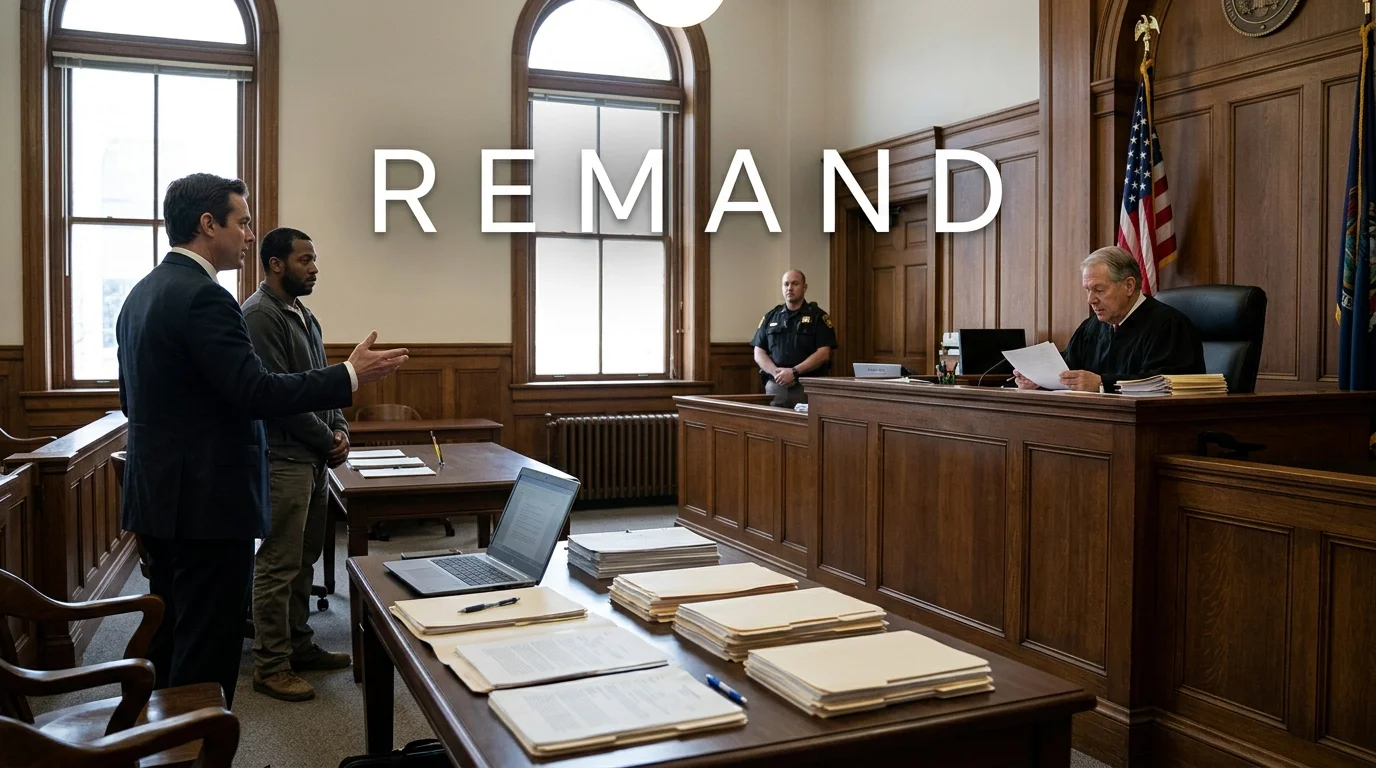
Legal language can make a routine procedural step sound more dramatic than it is. If you see the word remand in a U.S. court decision, it usually means a case or issue is being sent back for more action rather than ending at the reviewing court. What happens afterward depends on who issued the order and what instructions the receiving court or agency must follow.
In U.S. law, the term usually means a court sends a case back to a lower court, state court, or agency for more proceedings. In criminal contexts, it can also describe returning an accused person to custody. The practical effect depends on the order, jurisdiction, and procedural stage.
| Key question | Short answer |
|---|---|
| What is the basic meaning? | A case, issue, or sometimes a person is sent back for further action |
| Who commonly sends a case back? | An appellate court, federal district court, or reviewing court |
| Does the original decision always disappear? | No. The order may affirm some parts while changing or vacating others |
| Does the case automatically start over? | No. Further proceedings depend on the instructions in the order |
| Can a federal case return to state court? | Yes, especially when a removed case does not belong in federal court |
| Can the term involve custody? | Yes. In criminal usage, it can refer to returning an accused person to custody |
| Is it the same as dismissal? | No. A returned case normally continues unless another ruling ends it |
Key Takeaways
- A higher court can send a case back while giving the lower court specific instructions.
- A returned case does not necessarily mean either side has completely won or lost.
- Federal courts can return improperly removed civil cases to state court.
- Courts may also return administrative matters to government agencies for additional consideration.
- Criminal usage can involve returning an accused person to custody pending later proceedings.
- The written order and appellate mandate determine what the receiving court may do next.
What Does Remand Mean in U.S. Law?
The U.S. Courts glossary defines the concept as an appellate court sending a case to a lower court for further proceedings. That definition captures the most common use in American appellate practice. The lower court then continues the case under the higher court’s ruling rather than treating the appeal as a separate lawsuit.
The word also has broader legal uses. Cornell Law School’s Legal Information Institute notes that a case may be returned to a lower court or agency, while an accused person can also be sent back into custody. Readers looking for related plain-English legal material can browse Magazetter’s Law archive.
Four Common Ways Courts Use the Term
1. An appellate court sends a case back to a lower court
An appeal does not always end with a simple statement that one party wins. Under 28 U.S.C. § 2106, federal appellate courts have authority to affirm, modify, vacate, set aside, or reverse decisions and send matters back for appropriate further proceedings. The resulting instructions may require the trial court to reconsider an issue, apply a different legal standard, enter a particular judgment, or conduct additional proceedings.
The scope can be narrow or broad. An appeals court might leave most of a judgment intact while ordering the trial judge to reconsider one damages issue. In another case, a major trial error could require proceedings that affect much more of the original judgment.
2. A federal court sends a removed case back to state court
A civil lawsuit filed in state court can sometimes be transferred into the federal system through the removal process. Federal jurisdiction must still exist, and procedural requirements also apply. When the federal court determines that the case should not remain there, it may return the lawsuit to the state court where it began.
Federal law contains specific rules for that process. Under 28 U.S.C. § 1447, certain objections to removal must generally be raised within 30 days, while lack of subject-matter jurisdiction requires the federal court to send the case back if the problem appears before final judgment. Once the appropriate order is sent to the state court, that court can continue the case.
3. A reviewing court sends a matter back to an agency
Courts also review decisions made by federal agencies and other administrative bodies. A reviewing judge may decide that an agency needs to reconsider evidence, explain its reasoning more fully, apply the correct standard, or conduct another proceeding. The court does not always substitute its own factual decision for the agency’s work.
The agency then handles the matter within the boundaries set by the reviewing decision. Some federal regulations expressly provide procedures for cases returned to administrative judges, boards, or other decision-makers. Readers interested in how administrative legal rules can affect individuals may also find Magazetter’s NYS disability benefits guide useful as a separate example of a rules-based benefits process.
4. A criminal defendant is returned to custody
The same legal term can sometimes describe what happens to an accused person rather than a lawsuit. A judge may order a defendant returned to custody while the criminal process continues. That usage is different from an appeals court sending a file back to a trial judge.
The meaning of custody should therefore be read in context. A news report about someone being “remanded into custody” is discussing detention, while an appellate opinion about a case being sent to a lower court concerns judicial procedure. The two uses share the idea of sending something or someone back, but their legal consequences are different.
What Happens After a Case Is Sent Back?
The next step comes from the higher court’s written directions. The lower court normally must follow the appellate mandate and cannot treat the prior appeal as though it never happened. The parties may then return to briefing, hearings, trial preparation, resentencing, damages proceedings, or another task the reviewing court identifies.
Several outcomes are possible after the file returns:
- A limited issue is reconsidered. The trial judge may examine one specific question under a corrected legal rule.
- Further evidence or proceedings are required. The court may hold a hearing, make new findings, or conduct another phase of the case.
- A new judgment is entered. The higher court may provide directions that substantially determine what judgment should follow.
- A new trial may occur. This can happen when the appellate decision requires it, but it is not automatic.
- The case continues in state court. This commonly follows a federal order returning an improperly removed action.
The distinction matters because headlines can make the event sound like a complete restart. A returned case may have only one unresolved issue, while every other part of the earlier ruling remains effective. Reading the actual order is the safest way to learn how much of the case remains open.
How It Differs From Reversal, Vacatur, Dismissal, and a New Trial

Legal decisions often use several procedural terms together, but each does a different job. A higher court can reverse or vacate a decision and then send the matter back, which is why the terms often appear in the same opinion. A dismissal or new trial is a separate outcome and should not be assumed merely because a case is returning to another court.
| Court action | Basic effect | Does litigation necessarily continue? |
|---|---|---|
| Send the case back | Returns the matter for specified further action | Often |
| Reverse | Rejects or overturns all or part of a lower ruling | Depends on the accompanying instructions |
| Vacate | Removes the legal effect of a judgment or order | Often, but context controls |
| Dismiss | Ends a claim or case, subject to the form of dismissal and possible appeal | Not always |
| Order a new trial | Requires the disputed matter to be tried again | Yes, unless another resolution occurs |
This is also different from alternative dispute resolution. Magazetter’s guide to mediation and how it works explains a process in which parties try to negotiate a settlement with help from a neutral third person. A court-directed return, by contrast, remains part of the judicial or administrative process.
Does Sending the Case Back Mean Someone Won?
Not necessarily. One party may have succeeded on an important appellate argument while still facing more litigation in the trial court. A higher court can agree that an error occurred without resolving every factual or legal question necessary for a final outcome.
Consider a criminal appeal involving evidence used at trial. If a reviewing court finds that the trial judge applied the wrong legal rule, further proceedings may be required before anyone knows the final result. Magazetts ‘ Guide to Exculpatory Evidence and the Brady Rule covers a related area where evidence issues can affect criminal proceedings and post-conviction claims. Also worth reading: Is Reselling Legal in the U.S..
The same principle applies to civil litigation. A business might win an appellate ruling about the correct damages formula but still need a lower court to calculate the amount. The opposing party therefore may lose one legal argument without losing the entire lawsuit.
A Simple Example of How the Process Works
Imagine that a trial court decides a civil case using the wrong standard for determining damages. The losing party appeals, and the appellate court agrees that the legal standard was incorrect. Instead of calculating the damages itself, the appellate panel directs the trial court to reconsider that part of the dispute under the proper rule.
The case then returns to the trial court. The judge follows the higher court’s instructions, receives whatever additional arguments or evidence the order permits, and issues the required ruling. Other portions of the original case may remain untouched if the appellate decision did not disturb them.
This example explains why a send-back order should not be translated as “the entire case was overturned.” Its effect depends on the specific issues reviewed and the mandate’s language. Two cases with similar headlines can therefore have quite different procedural consequences.
What Should You Check in an Actual Court Order?
Start with the final section of the appellate opinion or order. Courts often state whether they affirm, reverse, vacate, modify, or return a judgment for specific proceedings. The mandate and surrounding reasoning help define what the lower court may address.
Look for these details.
- Which parts of the earlier judgment remain in effect.
- Which findings or rulings were rejected.
- Whether the lower court received specific instructions.
- Whether additional evidence may be considered.
- Whether a new hearing, trial, or sentencing proceeding is required.
- Whether any deadlines apply.
- Whether the dispute returns to state court, a trial court, or an agency.
Court procedure can vary by jurisdiction and case type. Anyone involved in an active lawsuit should review the specific decision with a lawyer licensed in the relevant jurisdiction rather than relying on a general definition. Magazetter’s guardianship process guide offers another example of why you must consider court procedures and state-specific requirements in context.
Frequently Asked Questions
Does remand mean the case is over?
No. It usually indicates that more action will occur before another court or decision-maker. The exact next step depends on the higher court’s instructions and on which parts of the earlier decision remain valid.
A narrow appellate ruling may leave most of the original judgment unchanged. A broader ruling may require substantial additional proceedings. The order itself determines which situation applies.
Does a returned case always lead to a new trial?
No. The lower court might need only to reconsider one issue, make additional findings, recalculate damages, or enter a different judgment. A new trial occurs only when the governing order or applicable procedure requires it.
That distinction can save readers from misinterpreting court news. The phrase “case sent back” describes the direction of the case, not a guaranteed procedural outcome. The next proceeding could be much smaller than a full trial.
Can a federal court send a lawsuit back to state court?
Yes. This commonly arises after a defendant removes a lawsuit from state court to federal court and the federal judge determines it cannot properly remain there. Federal statutes govern both the removal process and the circumstances for returning an action.
Subject-matter jurisdiction is especially important. Section 1447 states that a removed case must be returned if the federal court lacks that jurisdiction before final judgment. Other removal defects follow separate procedural rules and deadlines.
Is being returned to custody the same thing as a case being sent back?
No. One use concerns the physical custody of an accused person, while the other concerns where a legal matter will proceed. Context usually makes the intended meaning clear.
U.S. appellate materials most often use the term for sending a case to a lower tribunal for further proceedings. Criminal reporting may use related wording when a defendant is ordered back into custody. Before drawing conclusions, readers should identify whether the sentence refers to a person or a case.
The Bottom Line
A higher court sending a matter back does not tell you the whole result by itself. The most important questions are what decision was changed, what remained intact, and what the receiving court or agency was instructed to do. Those details determine whether the next stage involves a limited hearing, new findings, another judgment, state-court proceedings, or a larger reopening of the dispute.
For a live legal matter, read the complete order and any mandate rather than relying on a headline or docket label. State and federal procedures can differ, and deadlines may affect what a party can do next. A licensed attorney in the relevant jurisdiction can explain how the order applies to the specific case.